
Dermatology ConsultationTreatment
Electrocautery
 Dermatology Consultation
At a glance
- Procedure time
- Usually 10-30 minutes, depending on the number of lesions
- Anaesthesia
- Local anaesthetic; numbing cream for very small lesions
- Results start
- The crust usually falls off within 7-14 days
- Results last
- A removed lesion usually does not recur in the same spot; new lesions may develop over time in prone people
- Back to routine
- Back to daily life the same day
- Sessions
- Usually a single session; many lesions may be split over several visits
Electrocautery is a dermatological procedure in which electrical energy is converted to heat at a fine tip to remove small, benign skin lesions in a controlled way. It is done in the clinic under local anaesthetic and is most often used for skin tags, seborrhoeic keratoses, cherry angiomas and some warts.
Because the tissue is destroyed by heat, it cannot be sent for laboratory examination. Electrocautery is therefore used only on lesions judged benign at examination; anything suspicious needs a clear diagnosis first.
How does it work?
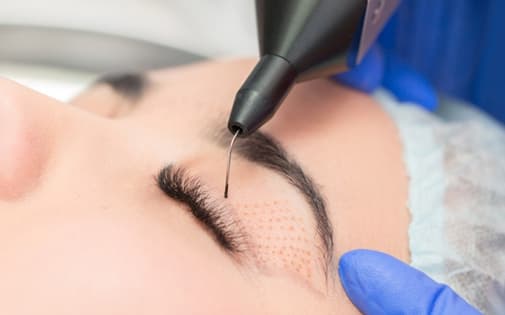
A high-frequency current passing through the tip creates heat in the tissue it touches. The heat dries out and coagulates the lesion while sealing small vessels, so bleeding is minimal. The treated tissue is gently wiped or curetted away, layer by layer, until healthy skin is reached. The energy level and depth are adjusted to the lesion and its location.
What can it treat?
- Skin tags: soft, skin-coloured growths on a stalk, common on the neck, armpits, eyelids and groin.
- Seborrhoeic keratoses: brown, rough, "stuck-on" benign growths that appear after middle age.
- Cherry angiomas: small, bright red vascular spots, mainly on the trunk.
- Syringomas and sebaceous hyperplasia: small skin-coloured or yellowish bumps on the face.
- Some warts: especially single stubborn warts and filiform warts on the face; see wart treatment.
- Spider angiomas on the face.
A skin tag is not a mole. Pigmented moles (naevi) are made of pigment cells, and if there is any doubt about them, surgical mole removal is preferred so the tissue can be examined.
Who is it suitable for?
It suits people with small lesions confirmed as benign that catch on clothing or jewellery, bleed, become irritated by shaving or are a cosmetic concern. Many small skin tags can be removed in one session. For some superficial lesions, cryotherapy or plasma treatment may be alternatives, depending on the lesion, its location and your skin tone.
How is it done?
- The lesions are examined, with dermoscopy when needed. Any lesion not clearly benign is not cauterised.
- We explain healing and possible side effects. Please tell us about a pacemaker, implanted defibrillator or blood thinners.
- The skin is cleaned and numbed with a small injection; numbing cream may be enough for tiny lesions.
- The lesion is treated with the tip and residual tissue is gently removed.
- An ointment is applied, with a small plaster if needed.
You will feel a brief sting from the anaesthetic injection; after that, most people feel no pain during the procedure itself.
Sessions and healing
Most lesions are removed in a single session; many lesions may be split over several visits. A crust forms and usually falls off within 7-14 days. The pink skin underneath gradually blends in over the following weeks.
Aftercare
- Apply the recommended ointment thinly until the crust falls off.
- You may be advised to keep the area dry on the first day, then wash gently.
- Do not pick the crust; this increases the risk of a mark.
- Avoid make-up on the area until it has healed, and protect it from the sun for a few months.
Possible side effects
Temporary redness, crusting and tenderness are common. A small pale mark or temporary darkening can remain, more often in darker skin and with deeper lesions. Infection, bleeding or, in prone people, a raised scar (keloid) are uncommon. People prone to skin tags may develop new ones elsewhere over time; this is not a recurrence of the treated lesion.
Who should not have it?
Electrocautery is not used on undiagnosed or suspicious lesions, or on areas with active infection or cold sores. People with a pacemaker or implanted defibrillator are assessed beforehand so the appropriate device and technique can be chosen. Extra care is taken in people prone to keloids, and elective procedures are usually postponed in pregnancy.
At our clinic in Çankaya, Ankara, we examine your lesions and discuss whether electrocautery or another method is the right fit for you. You are welcome to book a consultation.
The information on this page is for general guidance and does not replace a consultation or medical advice. Diagnosis and treatment decisions are made by your doctor. Last updated:
Electrocautery
Frequently asked questions
Common questions about Electrocautery, with short answers.
Does skin tag removal with cautery leave a scar?
The risk is low for small skin tags, and the area usually blends in within weeks. A small pale mark or temporary darkening can remain. Leaving the crust alone and protecting the area from the sun reduce the risk.
Does electrocautery hurt?
You will feel a brief sting from the local anaesthetic injection. Once the area is numb, most people feel no pain during the procedure, with mild soreness afterwards.
Will new skin tags appear after removal?
The removed tag usually does not grow back in the same place. People prone to skin tags may develop new ones elsewhere over time, which is due to the tendency, not the procedure.
Can people with a pacemaker have electrocautery?
It may be possible, but you must tell us beforehand. The appropriate device and technique are chosen, with a cardiology opinion if needed.
Can moles be removed with electrocautery?
Pigmented moles are examined first. Moles with any suspicious features are removed surgically so they can be sent to pathology, rather than cauterised.
Have another question?
You can ask us about visits and treatments by phone or on WhatsApp.
Message us on WhatsAppDermatology Consultation
Related treatments
Cryotherapy
Cryotherapy is a dermatological treatment that destroys unwanted skin lesions by freezing them with liquid nitrogen. It is used for warts, seborrhoeic keratoses, actinic keratoses and other selected lesions.
Plasma Mole Removal
Plasma mole removal uses a small plasma arc from a pen-like device to vaporise small, benign lesions in the upper layers of the skin. It is used only on lesions a dermatologist has confirmed as benign.
Surgical Mole Removal
Surgical mole removal means removing a mole under local anaesthetic with a thin margin of healthy skin and sending it for pathology. It confirms the diagnosis of a suspicious mole.
Acne Treatment
Acne is an inflammatory condition of the hair follicles and oil glands that causes blackheads, whiteheads, red spots and sometimes deep cysts. Treatment is planned at a consultation based on its type and severity.
Psoriasis
Psoriasis is a chronic, non-contagious condition in which an overactive immune response causes red, scaly plaques on the skin. With the right treatment it can be kept under control for long periods.
Rosacea
Rosacea is a chronic condition of the central face causing flushing, persistent redness, visible small vessels and acne-like bumps. Trigger control and the right treatment can keep it under control.
Çankaya, Ankara